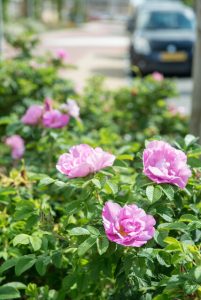
Roses on roundabouts
A nice-looking roundabout is a great showpiece for municipalities. Roses are highly suitable for use on roundabouts. They provide colour for months on end, capture particulate matter and increase biodiversity. Even better, roses can endure droughts with the best of them, and many varieties can tolerate (road) salt.
Air quality
Roundabout planting needs to be drought-tolerant, wind-resistant and low-maintenance. Many shrub roses and rugosa hybrids meet these criteria. In addition, depending on the edge finishing of the roundabout and its distance from the roadway, the planting may come into contact with road salt. Fortunately, many rose varieties are salt-tolerant. Rugosa hybrids will flower from mid-May until early in October. Rose breeders often select new roses for their self-cleaning properties: wilted flowers will fall off of their own accord. Roses can also capture particulate matter, such as nitrogen oxides (NOx) and ozone (O3). This means that they improve air quality.
Mechanical pruning
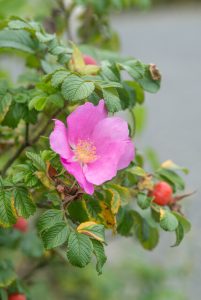
Among the Rosa rugosa hybrids, the lower varieties are particularly suitable for roundabouts. In autumn, their hips and golden-yellow leaf colour bring ornamental value. They can be pruned mechanically with a cutter bar or flail mower; depending on the desired appearance this is done annually to once every five years. Shrub roses usually have smaller leaves and lots of flowers. If planted on their own roots, they can be pruned mechanically, in which case the recommendation is once every 3 to 4 years.
Tips
- For a pleasing overall look, plant the planting beds at the roundabout in the same style.
- The number of roses per m² is 3 to 5 on average, depending on the rose variety.
- Varieties with semi-double flowers will attract insects.
- Roses are easy to combine with other shrubs, flower bulbs or perennials.
- Make sure to take the growing height into consideration when setting viewing angles for traffic. Some municipalities have rules for planting heights on roundabouts.